- TRAVEL PACKAGES
- BESPOKE JOURNEYS
- TOP TOURS
- Daily Tours
- PRACTICAL TRAVEL INFO
- DISCOVER VIETNAM
- PARTNER WITH US
21-06-2025
The Vietnam Education System Evolution is the ultimate way to understand the indomitable will of a resilient nation that has transformed itself through the power of knowledge. From the brutal “ignorance policy” of the French colonial era, which left the vast majority of the population illiterate, to the current aspiration of building a high-tech learning society, education has always been the key to national survival. This Vietnam Education System Evolution was ignited by President Ho Chi Minh’s “Mass Education” movement in 1945, a miraculous campaign that empowered millions to become masters of their own destiny. Today, with over 23 million students and a focus on digital transformation, Vietnam continues to prioritize educational reform as the most important driving force for socio-economic development. Let’s unlock the historical milestones and contemporary priorities that define this remarkable journey of enlightenment.
Ho Chi Minh, a pivotal figure in Vietnamese history, incisively detailed the Three biggest scourges under French colonial rule in Vietnam and Indochina: “giặc đói” (the scourge of hunger), “giặc dốt” (the scourge of ignorance), and “giặc ngoại xâm” (the scourge of foreign aggression). This analysis underscored the severe challenges faced on the path to independence. This article will focus on the scourge of ignorance and Vietnam’s significant progress in addressing this critical issue through educational reform.
During the French colonial period (1858-1945), most Vietnamese people lived in extreme poverty and hardship. Beyond economic exploitation and political oppression, the French colonialists systematically implemented an “ignorance policy.” This deliberate strategy aimed to suppress the intellectual development and national consciousness of the Vietnamese population.
The core goal of this policy was to maintain long-term domination by keeping the majority illiterate and uninformed, making them easier to control and preventing independence movements. The colonial education system served only a small minority—officials, landlords, or the wealthy—primarily training a subservient civil service for the ruling apparatus. French-style schools were scarce, tuition was expensive, and the curriculum was detached from Vietnam’s reality, lacking national cultural and historical values. Consequently, the vast majority had no opportunity for schooling, illiteracy was widespread, pushing society into a vicious cycle of poverty and backwardness.
It was in this harsh historical context that President Ho Chi Minh deeply and accurately identified the most serious problems the nation faced. From the very beginning of the revolutionary movement, he declared to the entire nation: “We are confronting three enemies: the enemy of hunger, the enemy of ignorance, and the enemy of foreign invaders.” These three “enemies” not only hindered the country’s development but also directly threatened the nation’s survival. Among them, “ignorance” was emphasized as one of the greatest dangers, because an uneducated nation would struggle to rise up, gain independence, and build a new life.

Immediately after the establishment of the Democratic Republic of Vietnam Government in 1945, President Ho Chi Minh led the nation in a total struggle to simultaneously combat and eradicate these three enemies. The campaign to eliminate “ignorance” was given top priority, considered an urgent and long-term strategic task.
The “Bình dân học vụ” (Mass Education) movement was launched vigorously across the country, from cities to rural areas, and from the lowlands to the highlands. With the slogan “Combat illiteracy,” classes were opened everywhere: village communal houses, pagodas, people’s homes, and even under trees. Everyone became a teacher or a student. The policy of “those who know how to read teach those who don’t,” and “adults learn from children,” created an unprecedented atmosphere of enthusiastic learning. In just a few short years, millions of Vietnamese people escaped illiteracy, became aware of their right to be masters of their country, and gained more confidence in the future. This was a magnificent miracle, demonstrating the correctness of President Ho Chi Minh’s vision and the immense potential of the masses.

In the modern era, especially since the Doi Moi (Renovation) reforms began in 1986, the Communist Party and the Vietnamese State have consistently upheld and valued the cause of education. Education in Vietnam is identified as a top national priority, the most important driving force for socio-economic development, improving the intellectual standards of the people, training human resources, and nurturing talent.
Education and training policies are always emphasized and heavily invested in at all levels of schooling, from preschool, primary, junior high, senior high, and higher education levels such as vocational training, intermediate, college, university, and postgraduate. The Vietnamese education system has expanded, diversifying types of schools and classes, and curricula are constantly being renewed to meet the country’s development requirements and international integration.
As of the 2023-2024 academic year, Vietnam has approximately 23.2 million students across the country. Specifically:
Regarding educational institutions in Vietnam:
Notable achievements in modern Vietnamese education include:

Despite significant achievements, modern Vietnamese education still faces shortcomings and numerous challenges that need to be overcome:
To overcome these limitations and enhance the substantive quality of education, Vietnam is continuing to push for educational reform with key orientations:

Conclusion: Vietnam’s Educational Ascent
From a nation grappling with “the enemies of hunger, ignorance, and foreign invaders,” Vietnam has risen powerfully, making education one of its top priorities. The achievements gained are proof of the will and aspiration of a nation that always values knowledge. Although there are still challenges to overcome, with the determination of the Party, the State, and society as a whole, Vietnamese education will undoubtedly continue to innovate and develop towards substantive, high-quality outcomes, contributing to the development of well-rounded citizens who meet the demands of the new era and affirm Vietnam’s position on the international stage.
The remarkable progress and Vietnam Education System Evolution are globally recognized and documented by major international education and development organizations. Vietnam’s achievements in universalizing primary education and improving literacy are extensively featured in reports by UNESCO and the World Bank. Furthermore, detailed statistics regarding enrollment rates and higher education reforms are available in global academic records on Wikipedia. These sources serve as a global testament to the strategic vision and unwavering dedication of the Vietnamese people to building a prosperous future through the power of education.
#VietnamEducation #DoiMoi #HoChiMinhLegacy #LearningSociety #EradicatingIgnorance #EducationalReform #HumanResources #NationalDevelopment #VietnamProgress #HigherEducationVietnam #VocationalTrainingVietnam #DigitalEducationVietnam #EducationStatisticsVietnam #LiteracyRateVietnam #VietnameseEducationSystem
Latest news

Health & Safety
19/08/2026Medical Tourism in Vietnam: Asia’s Emerging Healthcare Hub
Medical Tourism in Vietnam: Asia’s Emerging Healthcare Hub Vietnam is rapidly evolving beyond its reputation as a breathtaking holiday destination. Driven by strategic investments in healthcare infrastructure, an influx of internationally trained specialists, modern medical technologies, and a renowned culture […]

PRACTICAL TRAVEL INFO
11/08/2026Truth About Room Tiers & Meals in Vietnam Tour Packages
Why Lead-in Package Rates Protect Your Budget & Flexible Meals Unlock Ultimate Freedom By Dr. Son & Team – Luxury Vietnam DMC SPECIAL OUTLINE ABOUT VIETNAM TOUR PACKAGE PRICING The Sample Itinerary Misunderstanding: Why a sample tour is a baseline reference, not a rigid cage. Pillar 1: Demystifying Hotel & Cruise Room Tiers: Real-world price […]
PRACTICAL TRAVEL INFO
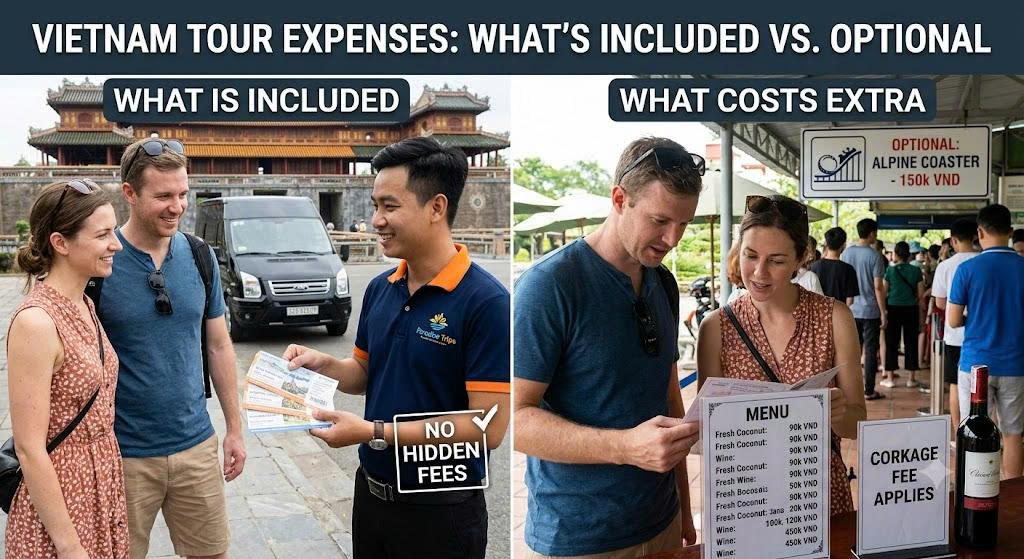
10/08/2026Vietnam Tour Hidden Fees: What Costs Extra and Why
The Truth Behind “No Hidden Fees”: Why You May Still See Paid Services Inside Attractions, Restaurants, Cruises, and Resorts in Vietnam One of the most common questions we receive from international travelers booking a private tour is: “If your package promises no […]