- TRAVEL PACKAGES
- BESPOKE JOURNEYS
- TOP TOURS
- Daily Tours
- PRACTICAL TRAVEL INFO
- DISCOVER VIETNAM
- PARTNER WITH US
26-06-2025
The Vietnam Political System Functions is the ultimate way to understand the unique and effective structure that has underpinned the nation’s stability and remarkable development. Unlike traditional Western models, Vietnam operates on a mechanism of “assignment, coordination, and control” among the legislative, executive, and judicial branches. This Vietnam Political System Functions is characterized by the paramount leading role of the Communist Party of Vietnam (CPV), with the General Secretary as the central figure. By institutionalizing Party resolutions into state laws through the National Assembly and executing them via the Government, Vietnam ensures a unified direction for national development. Let’s delve into the intricate mechanics of the “Four Pillars” and the foundational principles that steer Vietnam’s path toward a prosperous and developed nation.
SPECIAL OUTLINE
Get an immediate grasp of our article’s core and structure through these key highlights:
Please note: In this article, we’ll focus on analyzing the upper echelons of Vietnam’s political system, covering its core power organs and key leadership positions. Listing every single agency, ministry, department, and mass organization within the administrative-political machinery would be too broad and beyond the scope of this in-depth analysis.
The formation and evolution of the modern Vietnamese state is a testament to the nation’s enduring spirit of independence. After decades of colonial rule, on September 2, 1945, at historic Ba Dinh Square, President Ho Chi Minh read the Declaration of Independence, giving birth to the Democratic Republic of Vietnam. This monumental event marked the dawn of the first independent, self-governing state in modern Vietnamese history.
Following the Great Spring Victory of 1975, the country was fully unified. In 1976, to align with the new national context and development goals, the Constitution was amended, officially renaming the country the Socialist Republic of Vietnam. This name remains to this day, signifying the nation’s chosen path and developmental objectives.
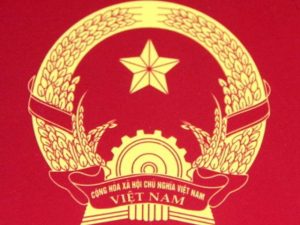
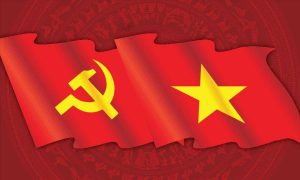
Within Vietnam’s political system, the Communist Party of Vietnam (CPV) is far more than just a political party. It serves as the paramount core, comprehensive, and absolute leading force for both the State and society as a whole. This distinctive role is clearly enshrined in the Constitution and fundamentally shapes how the political machinery operates:
The Party’s leadership, with the General Secretary at its core, is the fundamental factor maintaining political stability, serving as a solid foundation for Vietnam’s economic development and extensive international integration.
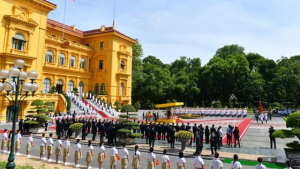
In the state’s power hierarchy, the State President is ranked second, directly after the General Secretary, and is one of the crucial “Four Pillars” (Tứ trụ). This position does not exclusively belong to the Legislative, Executive, or Judicial branch but serves as the head of state, representing Vietnam both domestically and internationally. The State President is elected by the National Assembly and is accountable to it.
The State President holds significant powers, including:
The State President’s role carries high symbolic importance regarding national sovereignty while also possessing real power in coordinating and overseeing the state apparatus and representing the country on the international stage.
While not adhering to the traditional Western model of “separation of powers,” Vietnam’s state system distinctly assigns roles to the Legislative, Executive, and Judicial branches. Crucially, the relationships and hierarchy among key leadership positions within the state apparatus form a unique characteristic of Vietnamese politics, often referred to as the “Four Pillars.”
The National Assembly is the highest representative body of the people and the supreme organ of state power. In its legislative role, the National Assembly holds key powers and responsibilities:
The National Assembly Chairman is the head of the Legislative Branch and is typically ranked as the fourth of the “Four Pillars.” This position is responsible for overseeing the National Assembly’s activities, ensuring the Party’s directives are institutionalized into law, and playing a vital role in supervising and upholding the constitutionality and legality of the state apparatus.
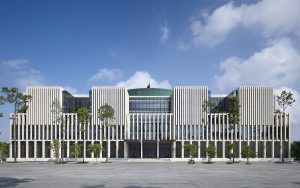
The Government, headed by the Prime Minister, is the highest state administrative body. It performs the executive function, responsible for:
The Prime Minister is the head of the Executive Branch and is usually ranked as the third of the “Four Pillars.” This position wields significant practical administrative power, directly overseeing all aspects of socio-economic life, national defense, and security, turning guidelines and policies into concrete actions.
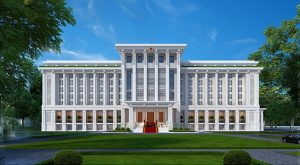
Vietnam’s judicial system comprises two main bodies: the People’s Courts (headed by the Chief Justice of the Supreme People’s Court) and the People’s Procuracy (headed by the Prosecutor General of the Supreme People’s Procuracy). These two bodies work collaboratively to ensure the enforcement of laws and the upholding of justice:
The positions of Chief Justice of the Supreme People’s Court and Prosecutor General of the Supreme People’s Procuracy are generally not part of the “Four Pillars.” This reflects that, while judicial power is highly valued for its independent adjudication and adherence to law, the overall political decision-making and comprehensive national administration are more concentrated in the higher “Four Pillars” positions, and especially in the General Secretary.
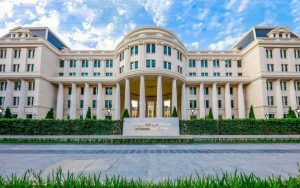

In international relations theory, foreign policy is often viewed as an extension and continuation of domestic policy, stemming from a nation’s core internal interests and values. Vietnam is a clear illustration of this perspective. Vietnam’s foreign policy, guided by principles of independence, self-reliance, multilateralization, and diversification of relations, is a concrete manifestation of national development goals and the protection of national interests as defined by its internal political apparatus.
To emphasize its independence, self-reliance, and its flexible, adaptable approach in a dynamic international environment, Vietnam adheres firmly to key principles:
These principles, combined with the spirit of “Bamboo Diplomacy,” articulated by General Secretary Nguyen Phu Trong, have become a vivid symbol of Vietnam’s foreign policy. It embodies a harmonious blend of steadfast principles and flexible responsiveness:
This foreign policy has enabled Vietnam to expand its network of partners, deepen international economic integration, and elevate its global standing, all serving the ultimate goal of sustainable domestic development.
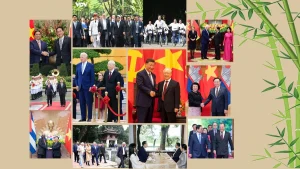
Understanding the historical formation, the structure of Vietnam’s political system, the operational mechanism of its three branches of power with their distinct hierarchies (especially the position of the State President), and the paramount, core leadership role of the Communist Party of Vietnam, provides a profound and comprehensive view of this nation’s internal foundations. This unique blend of democratic centralism, functional division, coordination, and a clear power hierarchy, along with an independent and self-reliant foreign policy based on the “Three Nos,” “Four Nos,” and “Bamboo Diplomacy,” has contributed significantly to maintaining political stability. This stability lays a solid groundwork for Vietnam’s ongoing innovation and socio-economic development, as it strives to become a developed nation and contributes actively to regional and global peace and prosperity.
The strategic depth and Vietnam Political System Functions are globally recognized and analyzed by international governance and academic institutions. Vietnam’s constitutional framework and the leadership of the CPV are extensively documented by the National Assembly of Vietnam and analyzed for regional stability by the United Nations Development Programme (UNDP). Furthermore, detailed historical records of the state’s evolution and its “Bamboo Diplomacy” principles are available on Wikipedia. These sources serve as a global testament to the resilience, stability, and strategic unity that define Vietnam’s political landscape in the 21st century.
#VietnamPoliticalSystem #VietnamGovernment #PoliticalStructure #CommunistPartyOfVietnam #CPV #GeneralSecretary #StatePresident #PrimeMinisterVietnam #NationalAssemblyVietnam #FourPillars #SeparationOfPowers #BambooDiplomacy #ForeignPolicyVietnam #ThreeNosPolicy #FourNosPolicy #IndependentForeignPolicy #PoliticalStabilityVietnam #VietnamDevelopment
Latest news

Health & Safety
19/08/2026Medical Tourism in Vietnam: Asia’s Emerging Healthcare Hub
Medical Tourism in Vietnam: Asia’s Emerging Healthcare Hub Vietnam is rapidly evolving beyond its reputation as a breathtaking holiday destination. Driven by strategic investments in healthcare infrastructure, an influx of internationally trained specialists, modern medical technologies, and a renowned culture […]

PRACTICAL TRAVEL INFO
11/08/2026Truth About Room Tiers & Meals in Vietnam Tour Packages
Why Lead-in Package Rates Protect Your Budget & Flexible Meals Unlock Ultimate Freedom By Dr. Son & Team – Luxury Vietnam DMC SPECIAL OUTLINE ABOUT VIETNAM TOUR PACKAGE PRICING The Sample Itinerary Misunderstanding: Why a sample tour is a baseline reference, not a rigid cage. Pillar 1: Demystifying Hotel & Cruise Room Tiers: Real-world price […]
PRACTICAL TRAVEL INFO
10/08/2026Vietnam Tour Hidden Fees: What Costs Extra and Why
The Truth Behind “No Hidden Fees”: Why You May Still See Paid Services Inside Attractions, Restaurants, Cruises, and Resorts in Vietnam One of the most common questions we receive from international travelers booking a private tour is: “If your package promises no […]